Category Archives: Editorials

Singing Songs off The Shoulder of Orion: An Interview with Sam Cook-Parrott

If Sam Cook-Parrott is anything, it’s prolific. With a catalogue of one album, three EPs, and a bunch of other ‘albumettes’ floating about under the name Radiator Hospital, his primary band–and that’s not including other bands he associates with like Photographers and Strawberry Heritage–Cook-Parrott’s bubblegum punk projects are leaking out of Grand Rapids and into music scenes across the Midwest.

With music on websites such as bandcamp and cllct.com, and with a recent release, Welcome To The Jungle, under local cassette/digital distributor extraordinaire Already Dead Tapes, Cook-Parrott has implanted his sound here in Kalamazoo.

My first contact with the artist was when I was cobbling together a film project, and his song “Michael & Barbara” caught my ear. I had discovered Cook-Parrott after local Strutt Booking Manager Andy Catlin shared the song on his site disclaiming “Dude writes wicked songs!” Well, how can one resist “wicked songs?” The bounding guitar and pleading vocals of “Michael & Barbara” seem reminiscent of a lonely kid on his couch trying to shake away some depressive doldrums with his only two friends: a guitar and his television—something that fit the mood of the solitary record store I was trying to portray. I got a hold of Cook-Parrott and he gave the go-ahead for using “Michael & Barbara” in my film.

Later, I would wrangled a few words from him in a subsequent interview, intrigued by the at-home, cassette-like hiss, and sci-fi femme fatal fascination  that has been a consistent theme for all of his records.

While working on multiple projects such as Winter Break and Strawberry Heritage the (latter formed with Frontier Ruckus member John Hanson) CP explained that Radiator Hospital is his main project and subsequently how it began. Like so many others, the project had its origins in another band. “I had a band (Cookie Bumsted), in high school, that was like me and a bunch of friends. That sort of died out–not everyone was interested anymore,” he said.
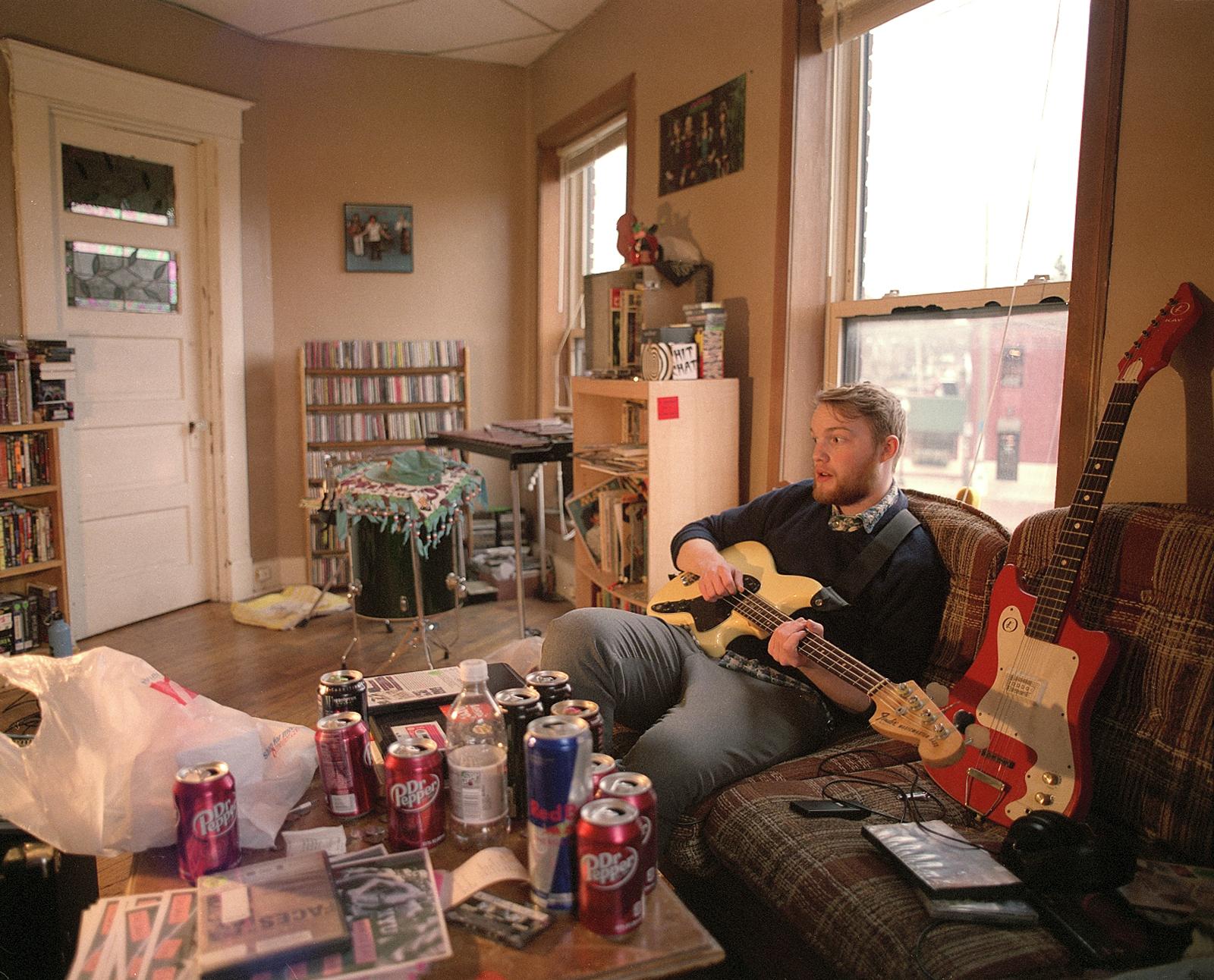
The Sam Cook-Parrot in his natural habitat.

Sam Cook-Parrot, for those that are not familiar.

Afterwards, Cook-Parrott wanted to revitalize the songs Cookie Bumsted had played.  “I thought it would fun to record all these songs we had and record in a different way, playing the instruments myself. Prince did it all himself. The Toms, a band from from the 70’s and 80’s, did it all themselves–that is the stuff that influenced me. Except it sound nothing like that; it ended sounding like typical lo-fi.”

This inspired Cook-Parrott to write on his own, eventually forming Radiator Hospital as a solo project with that same bedroom, lo-fi sound. “I ended up making a band that was bed-room rock and then sort of a punk band playing all these songs.”

As a result, Welcome To The Jungle, I Want To Believe, Can You Feel My Heart Beating?, and Nothing In My Eyes, amongst a flurry of random collections of singles and compilations, were produced under the Radiator Hospital sigil. Most of the earlier work was written by CP on his own, but eventually he just “wanted to play the songs live,” and formed a band around the music.

Radiator Hospital gathers much of its inspiration from the femmes of fiction. From the likes of Agent Scully (X-Files) to Rachael Tyrell (Blade Runner), female characters from film and television emblazon his album covers in a style reminiscent of The Smiths trademark: an old picture with a band-name. Cook-Parrott says he “likes the imagery of it, the idea of it. I am into cool sci-fi stuff, for the covers of the records [the women] are really strong image of this really beautiful girl looking at you.”

All of this is an “homage,” explains CP, “about how these people are a part of my life–even though they aren’t because I don’t know them.”

“There have been periods of time where I have spent days or weeks just watching X-files and writing songs.”

There is a fascination with fiction in CP’s writing, a desire for a world that only exists in the static glow of a television, and which he attempts to convey with the hiss-hum of his lo-fi pop. “I love the melodrama—stuff like ‘this moment is the most important moment of all time’ or ‘if this kiss doesn’t happen we’ll all die,’ and of course that isn’t how it is, but sometimes you do live those moments, as silly as that may be.”

For those interested in checking out Radiator Hospital, Strawberry Heritage, or any other of Sam Cook-Parrott’s work, just visit radiatorhospital.bandcamp.com or strawberryheritage.bandcamp.com, or see him play June 25th at the Old Dog Tavern with Strawberry Heritage.
R.I.P. Doc Watson and Earl Scruggs

The bluegrass guitar master Arthel “Doc” Watson died yesterday at the age of 89.  His death comes almost exactly two months after the passing of the great banjo player Earl Scruggs (88).

Both Scruggs and Watson are known for their invaluable contributions to both bluegrass music and their respective instruments.  Here’s the two of them playing a few tunes together back in the day (it takes a second to get to the music, but it’s worth it):

Though the death of an artist is always accompanied with sadness, the departure of these gentlemen comes after long lives of fantastic music.  Thus, I felt compelled to write this not out of mourning, but as a celebration of two of the greatest figures in American roots music.

Thank you, Doc and Earl.  Rest in peace.

How Anyone Can Make A Flyer To Promote Their Show Without Fail – A Lesson In Old School Show Promotion

It’s fairly simple to make a flyer. Though the imagery can be really important as far as grabbing someone’s attention, first and foremost is the importance to the details of the show. It does you no good to have an eye-catching image if information is missing, or is difficult to read, so keep in mind:
-Who is playing
– where are they playing
-if you can or cannot contain an address
-how much does it cost
-when is it
-and where can you find more information

The way I’ve been designing flyers is to first draw the image that I want to use. I like to use high-contrast black and white as my style, as printing black and white is cheap, and you don’t want details getting muddled in the transition from color to b&w. You could do something much more detailed/colored/cut and pasted, which a lot of people have done to good effect as well. Just make sure you have in mind where your text will be, and that it can be big enough to be legible.

I’ve started designing my text on a separate piece of paper, and then digitally editing the text and image together. Depending on your style, or access to digital editing, this might not be viable. There’s always the effective old school way of cutting, pasting and xeroxing at kinkos. It works well, and requires no major computer knowledge.

Some other tips I can throw in is, if the show or event is free, make sure that’s known! Not having to spend money is really enticing. If you don’t collect a specific amount of money, but do have touring groups to help out, it would be good to include that donations are taken, just so people can know to have a bit of cash on them when they show up. In this digital age, telling people a website or a keyword to search for to find more information is generally a good idea. I make sure to put DITKalamazoo.com on all of my flyers.

Lastly, keep in mind that this is a fun way of having a bit of visual expression. You don’t need to be a visual artist to make a good flyer. Ann Arbor flyer maker Shelley Salant’s style is to make the only imagery on the flyer the relevant text, done in bold magic markers. This is clear, concise, attention grabbing, and is a signature style.

The Strutt is Gone

Last week saw the end of the Strutt’s run in their location at the corner of Academy and W. Michigan. While there are plans in the works for relocation, the future of shows in the new location seems to remain up in the air. What this means, at least for the moment, is that we’ve once again lost an important music venue in our city.

I’m sad to see it go, as I know many are. I’ve had the pleasure of seeing a number of national acts right here in town, only two measly blocks from my house, that I wouldn’t have otherwise. I’ve attended countless performances by my good friends alongside touring acts from all over the country and beyond. In addition, the Strutt had personally become my favorite local venue to play.

As is the nature of things, spots where people can put on shows come and go, and generally all too quickly. The lifespan of a venue – be it in a basement, bar, or art space – is often a few years at best. Any establishment that hosts live music of this nature, on the kind of intimate scale that we appreciate, is going to be a constant struggle to maintain. But one thing will always remain and will be paramount to its success: the spirit of real community.

Without it, the Strutt would have been just a building, just a business. But hopefully everyone reading this was lucky enough to experience the kinds of things I have over the last few years: moments of honest joy, moments that moved me, that inspired me. Yes, it has less to do with the place itself or the money that goes into it than it does with the musicians that are a part of it, the friends that share in it with you, the people that make it happen. These things are universals in our little subculture world and are a testament to the power that music has in our lives, and the Strutt played a role in bringing this into our most excellent city.

While a venue may not be the most sustainable venture and will all too often meet a premature end, this spirit must continue to be nurtured. Thankfully, at present there is a multitude of places to see live music here in Kalamazoo and for us to gather together, and if you’re reading this article that much should be clear. While there were many aspects of the Strutt that were unique and beneficial, hopefully those can be recaptured in a new space sometime in the near future. Regardless, Kalamazoo’s music culture continues to thrive and will do so as long as we all stay involved.

DIY Community Ethics

We’ve got something pretty great here, Kalamazoo. This loosely-defined yet tight-knit group of people who put together art and music events and publications is something that I try not to take for granted. This community offers Kalamazoo something different than the norms of society; something better than the monotony of a college town, or a low wage job.

I love this community for exactly that – the difference from overarching society.

That’s why I just wanted to say a few things about what can make a community like this really great. I’m not saying Kalamazoo necessarily lacks these things, in fact I don’t think we do. I just think that a group that is trying to break away from what really sucks about normative culture should better acknowledge just what sort of alternative we are looking for.

It’s great to see some genuine respect for those who are involved. At a show, this means respect for the bands – touring and local; the people who live at the house or run the venue; and the people who are attending the show, whether you know them or not. This applies to you, wherever you may fall on involvement. Bands should be aware that when they are up at a mic they have a larger control of the space than most anyone else in that room, and should pay attention to the things they say. People running a venue should try and not talk to people attending a show in a way that sounds authoritative or degrading. People attending the show should try and recognize the vast differences within the attendance population of a show, and realize that their actions and words will be perceived differently by a large number of people.

I say these things not because they are necessarily a problem in Kalamazoo, but because these are the sorts of things that should be considered by everyone involved in a community event space. Are you being respectful to those around you? Do you feel respected, or do you feel offended or unsafe? These are reasonable things to assess while you’re in a large group.

I don’t think these guidelines take away from the spontaneity or interest of the events that take place. I do think, however, that actions such as violence, groping, or flagrant hate speech would detract from the efforts of this community. Our normative society is all about being hateful, divisive, and marginalizing, and I personally don’t see a place for it here.

I fell into this community easily because I saw a group of people with a vast array of interests and ideals working together to have a good time and to appreciate art and music, while making friends. Had I come into this community and noticed a trend in violence, hate speech, sexual aggression, or an obvious marginalization of certain people, I would not have taken to this group. I imagine many people in this DIY community feel similarly.

On a personal level, I love that I can feel safe in this community as a female-bodied person, as a queer person, as a person of smaller stature, as a socially anxious person. However, that does not mean that I have never felt unsafe or treated with disrespect because of these things at shows. That doesn’t mean I have never heard other people express similar discomfort. We have a great community, but it’s not perfect, and can always be improved.

I say these things with the thought in the back of my head that much of what I’m saying is a no-brainer to most who read it. With that, people should not feel alone in the fact that the actions and words of other event-attendees (or hosts or bands) might have made them uncomfortable, and should feel that they are able to express that. If we as a group do not want hate speech at events, don’t let hate speech get off the hook when you hear it. Many other people probably have your back on this, and no one should feel uncomfortable calling out something that marginalizes certain people. If violence is making you uncomfortable, I’m sure you’re not the only one. We as a community can acknowledge that violence is unacceptable in this setting, and not allow it. All it takes is an understanding of the underlying values that go into a community like this. It’s not rules, it’s respect for your friends.

DIY ETHICS & KICKSTARTER

The website Kickstarter seems to be a rather ‘hot button’ issue in Kalamazoo as of late. After having some in depth conversations on the subject with various friends, I’ve decided to share my thoughts publicly. This is not meant as an attack on anyone and I only hope that reading this will inspire, educate and promote a healthy community.

For those of you that don’t know, Kickstarter is a website where anyone can set up an account and create a page where fans are encouraged to donate money in support of an endeavor. Most often this is used for musicians looking for help with a tour, recording, getting/replacing instruments and gear, etc. The artist sets a goal and is given a time frame in which to reach it. If they get enough pledges in time, the money is theirs. If not, back to square one. Rewards are offered based on the pledge amount just like an NPR drive. As I understand it, Kickstarter also keeps a small cut of the donations. I will use musicians as primary examples in this article but the ideas apply to any artist or self starter.

Kickstarter is great tool for the DIY musician and its popularity speaks for the giant shift the music industry has undergone in the last decade. It allows people to remain truly independent and not rely on big record labels to front money in exchange for creative control. It can also be used in hard times when the van breaks down before tour or someone decides to steal the band’s gear. The best part of it all is it’s 100% democratic. No one is forced to donate. If the project isn’t worth supporting or the rewards aren’t enticing, then the band is forced to re-evaluate. The problem with this system is it often promotes laziness. Usually the bands that get the best results are the ones that already have a great deal of success and may not need any help.

If a band is going to use this tool and ask for money, I want to know they have earned it. I want to see them work hard. I want them to do everything in their power to accomplish the goal on their own. If someone is going to claim to be a full time musician, then let’s see the 40 hours a week they’re putting into it. Everyone that decides to pursue a career in music has to make sacrifices. That could mean taking a low paying job in order to get time off for tour when needed or going without a great deal of comforts to lower the cost of living.

There are also many many ways a band can get around spending tons of money to reach their goals. The DIY lifestyle has been fine tuned for decades now and there are plenty of resources and ideas floating around in zines, the blogosphere, forums, community based websites and more. Reach out to friends and fellow touring bands and see what works for them. It’s surprising how much money can be saved when you DO IT TOGETHER.

This being said, a well recorded album can be very expensive and a long tour can easily leave a band with less money than they left with. Thousands of bands have recorded albums on their own for almost no money. Many of these sound great and have sold very well. However, to really create an album that can compare with anything on the radio, it can cost more money than most of us have ever seen in one place. Even if you have a friend with a professional recording studio, that doesn’t always mean they will record you for free. If someone is trying to make a living off their services, it’s important to be respectful of that. Be sure to research what kind of sounds can be achieved without going to an expensive studio. Some might find that a lo-fi sound is actually preferable.

If a band gets in a position where they can’t accomplish their goal without kickstarter, then it’s a good time to really consider whether it’s something they NEED to do. I understand that it’s almost impossible to get an album made without label support that’s worthy of heavy radio play. But if the band is putting the album out alone, do they really have the capability of getting this much attention? Plus, there are now more small independent record labels than ever before. Working with a label is no longer synonymous with compromise. It’s still important to be careful, but there are plenty of people out there that are interested in helping fund and promote good albums without getting in the way of creativity and often without making bands sign anything. Not to say that this will be an easy find. Be prepared for hundreds of emails with no responses. Again, let’s see some HARD WORK.

I encourage anyone thinking about donating via Kickstarter to really understand what they’re supporting. Is the band giving full disclosure? Are you helping someone that is truly about community? If a band does not have a realistic and honest breakdown of where all the potential money will go, that should be an immediate warning flag. Vague and ambiguous intentions leave too much room for dishonesty. As the saying goes, “The love of money is the root of all evil.” Everyone is susceptible to greed. I’ve seen multiple bands where everything on their merch table is sold on donation and they simply list how much was spent on each item. Integrity such as this is something we should all strive for.

At the end of the day, this all boils down to personal choice. Some might wonder what harm there is with a band having many fans willing to give them big money for recording, touring, promoting or reaching the ‘next level’. The problem I see is a slippery slope. It’s well known that laziness is detrimental to creativity. Turning to community for money instead of services can be dangerous. It’s the point where people turn into dollar signs and bands start to lose track of why they should be making music in the first place. When too many bands get into this frame of mind, it can ruin an entire community by creating a spirit of competition and greed.

If you’re going to be actively involved with art, DO IT FOR THE LOVE. Surround yourself with people that share your values. Keep your integrity at all costs. Respect others. Respect yourself. This is a new age of the music industry and anyone can be a strong positive influence. Be aware of your surroundings and don’t be afraid to ask questions.

DIT OR DIE

How to run a DIY Venue part 1: The Legwork

Running a DIY venue can be a rather daunting task, but is also very rewarding in many ways. It’s also a great way to get involved in the local scene, and more importantly, keep the music going. So we at DIT Kalamazoo are here to bring you some HOUSE SHOW TIPS!

1.Meet your Neighbors!

In my experience the most critical thing you can do to make sure your house shows run uninterrupted is to simply meet your neighbors. Go door to door let them know your plans for hosting events at your house, because these people most likely will be the ones who call your local boys in blue. Let them know when you’re planning events, assure them you’re going to be in complete control of the situation, and that it isn’t just some out of control party. Also, ask them when it would best work into their schedules for you to have shows (everybody has early mornings sometimes).

2. Exchange phone numbers.

Make sure your neighbors know to call you first if there are any problems whatsoever. Unfortunately, some people will never be down with noisy neighbors, but the fact that you took the time to meet them does nothing but paint a positive image of you, what you’re doing, and that you care about your community.

There will be more tips in the coming weeks on running your own house shows, but if you are seriously interested and would like real help, or you have more specific questions, you can always visit one of our meetings (every Sunday, 611 Cedar street, 4pm).

-SachTheCat